
 Frizzanti
 Naturali




 Vini bianchi
 Vini rosè
 Vini rossi
 Champagne
 Passiti
 Spumanti
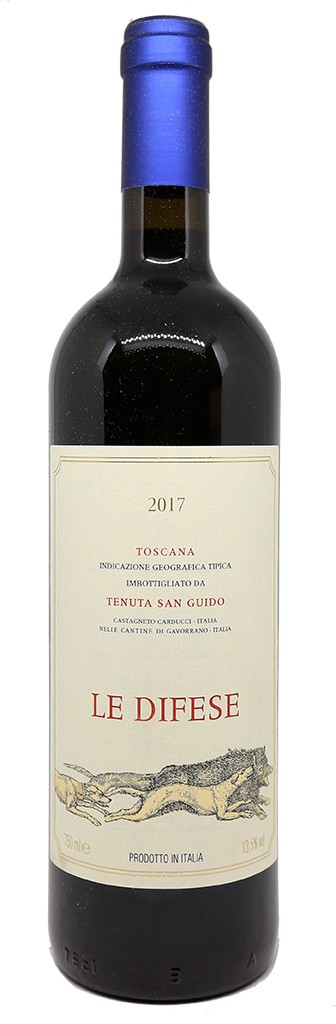
LE DIFESE – Tenuta San Guido BOLGHERI
La Tenuta San Guido è molto più conosciuta con il nome del suo vino più famoso: il Sassicaia . La tenuta si trova nella regione Toscana della Maremma , in Italia , e ha la propria denominazione DOC (Bolgheri Sassicaia) applicata al suo vino di punta. Tenuta San Guido produce anche Guidalberto e Le Difese da frutta declassificata del Sassicaia e altri vigneti della tenuta; questi due vini sono classificati IGT Toscana. L’azienda, in collaborazione con la Coop Santadi, è proprietaria anche dell’Agricola Punica in Sardegna.
Tenuta San Guido Le Difese 2017 (“Le Zanne ”) prende il nome dai denti del cinghiale che vagano per le colline toscane. È un blend di Cabernet Sauvignon (70%) e Sangiovese (30%) . La fermentazione avviene in vasche di acciaio inox a temperatura controllata e la macerazione dura dai 10 ai 13 giorni per il Cabernet Sauvignon e dai 13 ai 15 giorni per il Sangiovese. Viene poi affinato per 8 mesi in botti di rovere francese e americano e per altri tre mesi in bottiglia.
Il 2017 è stato uno degli anni più secchi dopo il 2003. Tuttavia, l’alternanza delle brezze marine durante il giorno e dei venti interni che soffiano di notte, ha impedito alle viti di soffrire di stress. Il particolare microclima di Bolgheri e Bolgheri Sassicaia è davvero essenziale in un’annata come il 2017. L’andamento climatico ha influenzato rese produttive mediamente inferiori del 20% rispetto alla norma. La qualità dei frutti non è stata intaccata e durante la vendemmia le uve sono risultate perfettamente mature, sane ed omogenee.
Varietà delle uve: 70% Cabernet Sauvignon, 30% Sangiovese
€25,00
Customer Reviews
Online Sports Nutrition and Natural Dietetics.
Chances are there wasn't collaboration, communication, and checkpoints, there wasn't a process agreed upon or specified with the granularity required. It's content strategy gone awry right from the start. Forswearing the use of Lorem Ipsum wouldn't have helped, won't help now. It's like saying you're a bad designer, use less bold text, don't use italics in every other paragraph. True enough, but that's not all that it takes to get things back on track.
The villagers are out there with a vengeance to get that Frankenstein
You made all the required mock ups for commissioned layout, got all the approvals, built a tested code base or had them built, you decided on a content management system, got a license for it or adapted:
- The toppings you may chose for that TV dinner pizza slice when you forgot to shop for foods, the paint you may slap on your face to impress the new boss is your business.
- But what about your daily bread? Design comps, layouts, wireframes—will your clients accept that you go about things the facile way?
- Authorities in our business will tell in no uncertain terms that Lorem Ipsum is that huge, huge no no to forswear forever.
- Not so fast, I'd say, there are some redeeming factors in favor of greeking text, as its use is merely the symptom of a worse problem to take into consideration.
- Websites in professional use templating systems.
- Commercial publishing platforms and content management systems ensure that you can show different text, different data using the same template.
- When it's about controlling hundreds of articles, product pages for web shops, or user profiles in social networks, all of them potentially with different sizes, formats, rules for differing elements things can break, designs agreed upon can have unintended consequences and look much different than expected.
This is quite a problem to solve, but just doing without greeking text won't fix it. Using test items of real content and data in designs will help, but there's no guarantee that every oddity will be found and corrected. Do you want to be sure? Then a prototype or beta site with real content published from the real CMS is needed—but you’re not going that far until you go through an initial design cycle.


Recensioni
Cancellare i filtriAncora non ci sono recensioni.